Most AI platforms store knowledge. SelfMinds AI is built to learn from it — and that distinction is becoming one of the most important gaps between AI systems that scale and AI systems that stall in the demo phase.
The problem with "just add a knowledge graph"
Retrieval-Augmented Generation (RAG) was the breakthrough of 2023–2024: give a language model access to your documents, and it stops hallucinating quite so often. It worked well enough to become the default. But industry benchmarking has made the ceiling of that approach clear. Independent production reports put plain RAG's hallucination reduction in roughly the 40–70% range (Blockchain Council, 2026) — meaningful, but nowhere near enough for high-stakes domains like healthcare, finance, or enterprise operations, where a wrong answer isn't a bad demo, it's a liability.
Graph-based retrieval closes that gap dramatically. A May 2026 benchmark from the MLOps Community, covering 47 production deployments, found that agentic pipelines pairing retrieval with a knowledge graph cut hallucination rates by an average of 62% compared to naive chunk-and-retrieve setups, drawing on data from real workloads across finance, healthcare, legal, and manufacturing (RAGaboutIt, 2026). Other enterprise benchmarking — including the Diffbot KG-LM Benchmark — has documented accuracy improvements of roughly 3.4× over standard RAG when relationship-aware retrieval replaces flat document search, with production deployments like LinkedIn's reporting a 78% accuracy boost after adopting graph-based retrieval (Atlan, 2026; Trantor, 2026). The pattern is consistent across the industry: structure beats statistical guesswork.
SelfMinds AI's architecture is built around that insight — but with a twist most competitors miss. We don't treat the graph as a lookup table. We treat it as a system that gets smarter every time it's used.
Four capabilities, one platform
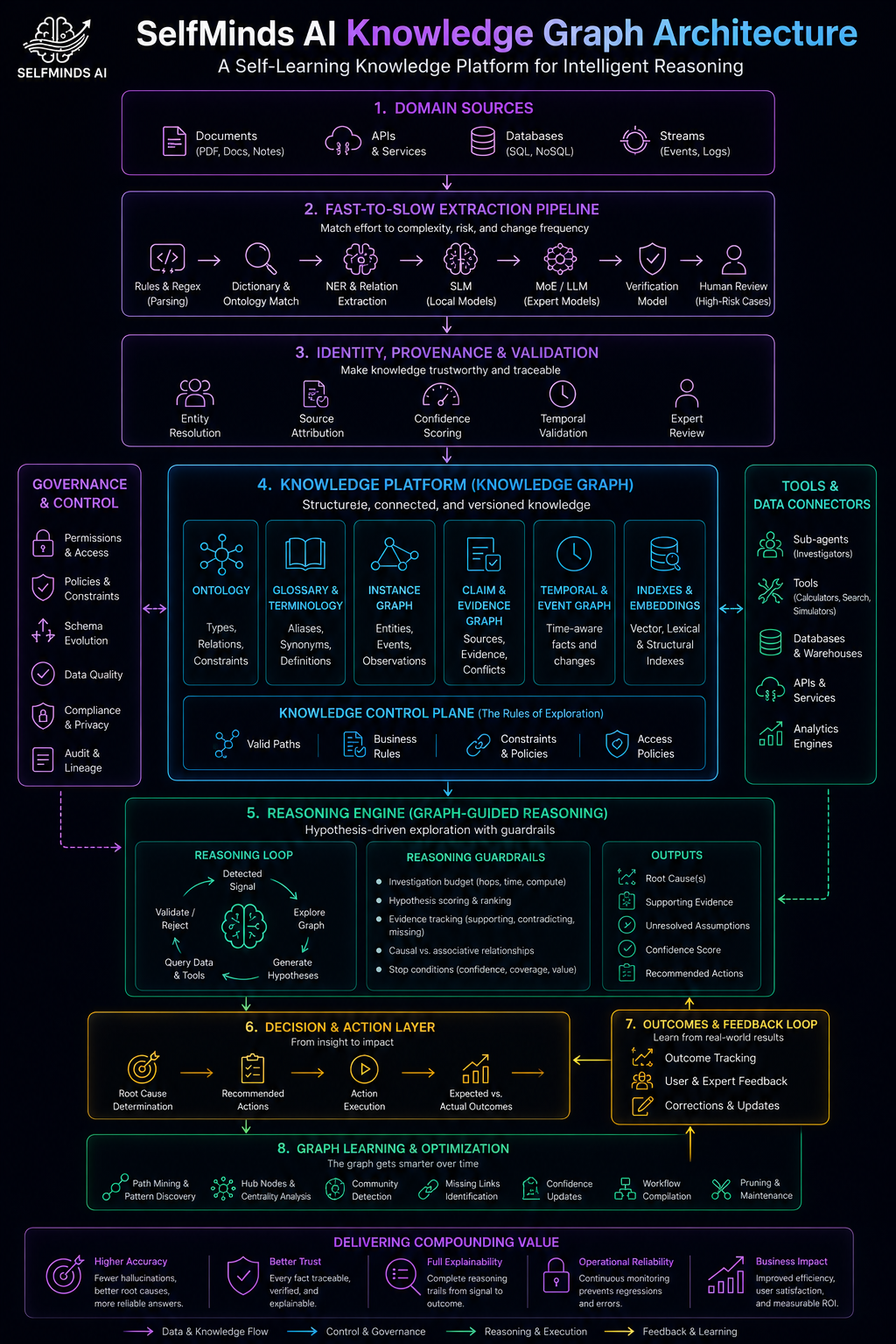
The SelfMinds knowledge platform is engineered around four core functions working together rather than in isolation:
- Knowledge construction — turning unstructured signals into structured, verifiable facts
- Graph-guided reasoning — using the graph to constrain and direct investigation, not just answer lookups
- Retrieval memory — routing each query to the right memory system automatically
- Structural learning and optimization — the graph improving its own shape and reasoning patterns over time
Most enterprise graph deployments stop at the first two. SelfMinds AI is designed around all four, because the fourth is where compounding advantage lives.
Extraction that matches effort to risk
Not every fact deserves the same processing cost. A patient's age is a parsing problem; a claim like "this finding changes treatment eligibility" is a judgment call that may need human review. Our extraction pipeline routes information through escalating tiers — regex and rule-based parsing, ontology and dictionary matching, named-entity and relation extraction, small local language models, and finally specialized or frontier-scale models with independent verification — based on task complexity, ambiguity, domain risk, and how frequently the information changes.
This tiered approach is also a direct extension of SelfMinds' broader model-routing philosophy: keep cheap, fast, local models (via locally-hosted models) doing the bulk of the work, and reserve expensive cloud reasoning models for the cases that actually require them. It's the same cost discipline we apply across our agentic pipelines, applied here to knowledge construction itself.
A graph that separates what things mean from what happened
A common failure mode in knowledge graphs is flattening everything into a single layer, which makes stable facts, situational claims, and time-sensitive data indistinguishable. SelfMinds AI's design explicitly separates:
- Ontology — entity types, relationship types, and constraints
- Glossary/terminology — synonyms, aliases, and domain-specific meaning
- Instance data — the actual people, products, organizations, and events
Every claim carries its own temporal metadata — when it became valid, when it was observed, when it was last verified — so the system can distinguish a fact that rarely changes (water is H₂O) from one that needs constant refreshing (the latest product model) from an event that should never be silently overwritten (a patient started a medication on a specific date). Multiple sources are allowed to disagree; the graph stores the conflict along with the evidence rather than forcing a false consensus.
Reasoning with guardrails, not guesswork
SelfMinds AI's reasoning agents don't traverse a graph indefinitely hoping to stumble on an answer. Every investigation runs against an explicit budget — hop limits, hypothesis caps, compute and time ceilings — and every hypothesis is scored against prior plausibility, graph relevance, evidence strength, source reliability, and temporal validity. The system actively tracks supporting evidence, contradicting evidence, and unresolved assumptions, and knows when to stop: high enough confidence, exhausted plausible paths, or a case that needs to escalate to a human.
This matters because causal and associative relationships are treated as fundamentally different things. "Correlates with" and "causes" are not interchangeable in our graph — a distinction that generic knowledge graphs frequently blur, and one that determines whether a root-cause analysis is trustworthy or merely plausible-sounding.
The differentiator: a graph that learns from its own traversals
Here's where SelfMinds AI's self-learning identity actually shows up in the architecture. The platform monitors which paths get traversed repeatedly, which nodes act as high-value hubs versus structurally central but semantically weak connectors, and which reasoning chains consistently succeed. When a path proves itself repeatedly — for example, tracing a specific type of failure from initial signal to root cause — the system compiles it into a reusable reasoning template, a "graph skill" that future queries can use directly instead of re-deriving from scratch.
That's a direct pipeline from exploratory reasoning → validated pattern → optimized workflow, and it's the same self-learning principle behind SelfMinds AI's broader platform vision: systems that don't just execute tasks, but get measurably better at executing them.
The loop closes with an outcomes layer: every recommended action, the action actually taken, and the observed result feed back into the graph's confidence scores and structure. Over time, the system learns not just what's true, but what actually works — turning root-cause detection into a continuously improving decision engine rather than a static analytics tool.
Built for environments where trust is non-negotiable
None of this matters without provenance. Every fact in a SelfMinds knowledge graph can answer: where did this come from, which model extracted it, when, and was it independently verified? Confidence is tracked at multiple levels — extraction, entity resolution, relationship, source reliability, and reasoning confidence — rather than collapsed into a single misleading score. Entity resolution is handled deliberately (is "Bob Smith" the same person as "R. Smith, Patient ID 12789"?) because incorrect merges are dangerous and excessive fragmentation is just as costly. And access control operates down to the node, property, and source-document level, so reasoning agents never traverse into data a user isn't authorized to see.
The bottom line
The AI industry is converging on a clear signal: as GenAI systems move from demos to production, general-purpose retrieval hits a wall, and the organizations pulling ahead are the ones treating structured, relationship-aware knowledge as core infrastructure rather than a bolt-on feature. SelfMinds AI was built around that shift from day one — not as a database with a knowledge graph attached, but as a self-learning reasoning platform where the graph, the retrieval layer, the reasoning agents, and the outcomes they produce are all part of one continuously improving system.
That's the difference between a system that answers questions and a system that gets better at answering them.
Interested in how SelfMinds AI's self-learning architecture applies to your domain? We design knowledge graph systems for healthcare, finance, enterprise operations, and any environment where the cost of a wrong answer is real.
Discuss Your AI Initiative →
Continue Exploring — Knowledge & Retrieval Series