Beyond RAG: Building Enterprise Memory for Reliable AI Agents
The future of Enterprise AI isn't a bigger language model — it's a better memory architecture. How layered knowledge systems make AI agents trustworthy, explainable, and production-ready.
The future of Enterprise AI isn't a bigger language model — it's a better memory architecture.
Artificial Intelligence has reached an exciting stage. Modern Large Language Models can write software, analyze medical literature, summarize thousands of pages of documentation, and reason across multiple domains. Pair them with Retrieval-Augmented Generation (RAG), and they become even more capable by incorporating your organization's knowledge into every response.
Yet despite these advances, one challenge continues to limit Enterprise AI adoption:
How do we ensure an AI agent retrieves the right knowledge — not just similar knowledge?
At SelfMinds AI, we believe answering this question requires rethinking how AI systems remember information. Instead of relying solely on vector databases, we design enterprise AI around layered knowledge, where authoritative information, historical documents, relationships, and live enterprise data each play distinct roles.
This architecture enables AI systems that are not only intelligent, but also trustworthy, explainable, and ready for production.
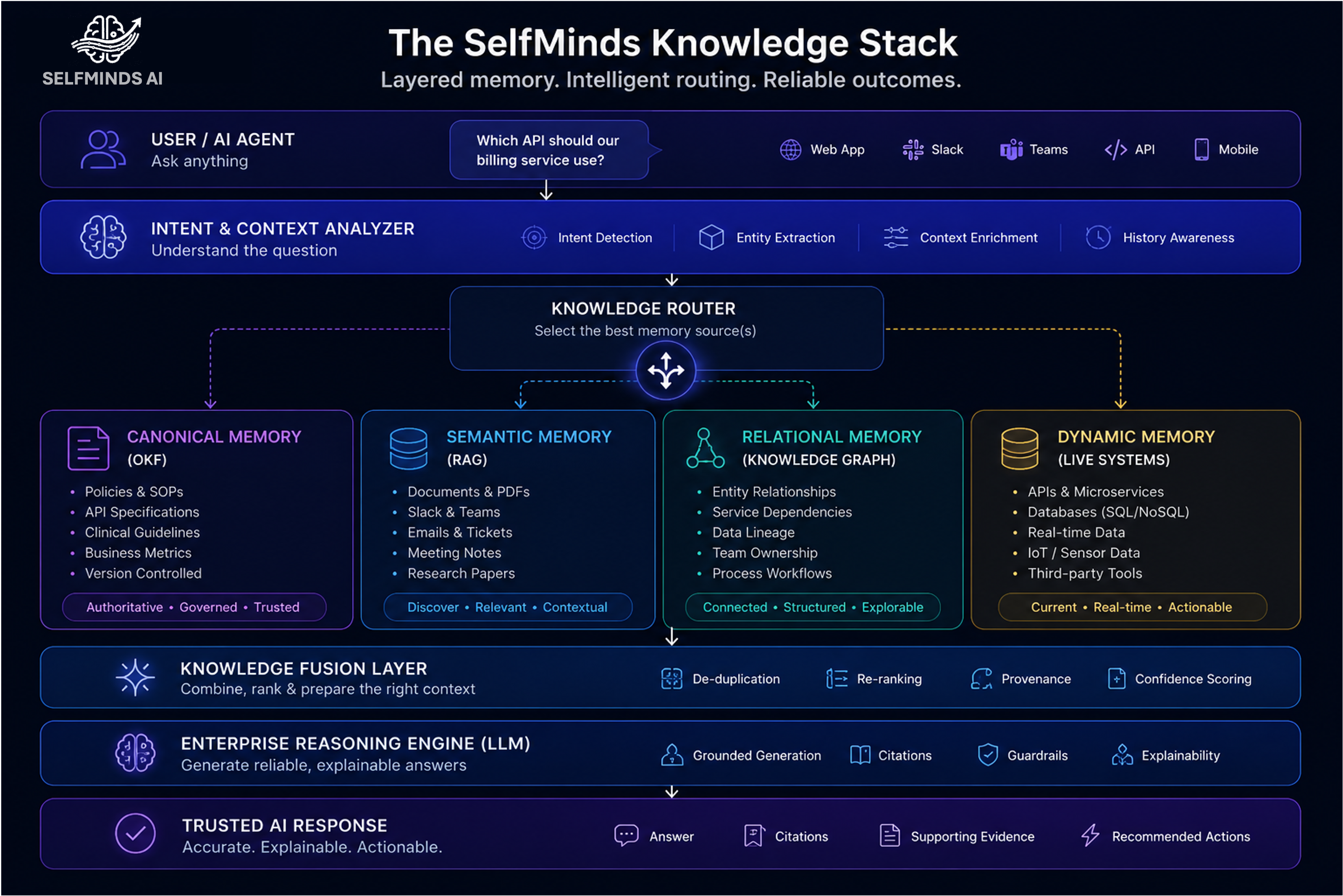
Figure 1 SelfMinds Knowledge Stack — canonical knowledge, semantic retrieval, and live data unified through a reasoning engine
Enterprise AI Has an Intelligence Problem — or Does It?
Imagine asking an enterprise AI assistant:
What is our official patient intake workflow?
Which API version should our billing service use?
What is the approved procedure during a cybersecurity incident?
Which machine learning model is currently deployed in production?
These questions seem simple. Yet inside most organizations, the answers may exist in dozens of places: Confluence, SharePoint, GitHub, Slack, Jira, PDFs, emails, internal wikis, architecture documents, source code.
Some documents are outdated. Some contradict one another. Some represent ideas rather than official policy. Traditional AI systems frequently treat them all as equally trustworthy.
The problem is no longer model intelligence. The problem is enterprise memory.
Why Traditional RAG Isn't Enough
Retrieval-Augmented Generation (RAG) has become the foundation of modern enterprise AI. A typical RAG pipeline collects enterprise documents, splits them into chunks, generates embeddings, stores them in a vector database, retrieves semantically similar content, and provides that context to an LLM.
This works remarkably well for searching documentation, research papers, meeting notes, support tickets, emails, and technical manuals. Semantic retrieval allows AI to discover information buried inside millions of documents.
But semantic similarity is not organizational truth.
Consider a company that has three API specifications, two archived incident playbooks, multiple Slack discussions, and an updated engineering handbook. A similarity search may retrieve any combination of these documents. An enterprise AI assistant should not guess which one is correct. It should know.
The SelfMinds Knowledge Stack
At SelfMinds AI, we separate enterprise knowledge into multiple memory systems instead of treating every document equally.
architecture
Rather than replacing RAG, we combine multiple knowledge sources and allow the AI agent to determine which ones are required for each task.
Knowledge Fusion
Reliable AI systems combine canonical knowledge, semantic retrieval, knowledge graphs, and live enterprise data into a unified context before generating responses. Fusion, not selection, is what separates production-grade AI from prototypes.
Four Layers of Enterprise Memory
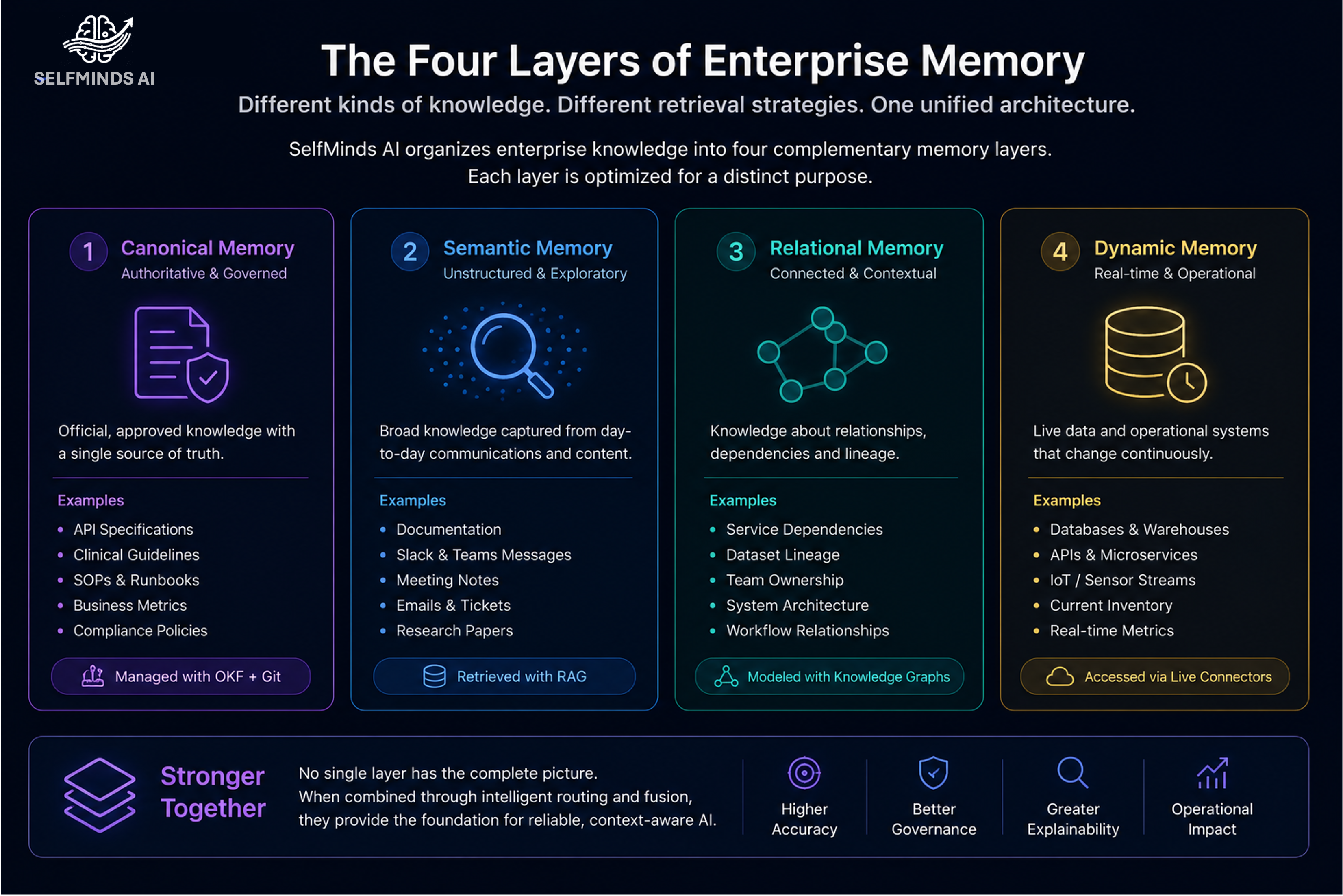
One of the biggest misconceptions in enterprise AI is that all knowledge should be stored in the same way. In practice, different kinds of information require different retrieval strategies.
Figure 2 Four Layers of Enterprise Memory — each layer serves a distinct retrieval purpose in the knowledge stack
1. Canonical Memory
This contains the organization's official knowledge — Standard Operating Procedures, API specifications, business metrics, clinical guidelines, compliance policies, and security procedures. These documents should be reviewed, version controlled, and governed. An emerging open standard for this type of knowledge is the Open Knowledge Format (OKF), which stores authoritative information as structured Markdown files with YAML metadata. Because OKF is human-readable, Git-native, and vendor-neutral, it provides an excellent foundation for canonical enterprise knowledge.
Canonical Memory
Official organizational knowledge with a single approved version. Examples include API specifications, clinical guidelines, business metrics, compliance policies, and SOPs. Canonical memory should be version-controlled, reviewed, and governed.
2. Semantic Memory
Semantic memory contains information that is useful but not necessarily authoritative — Slack discussions, meeting transcripts, research papers, internal documentation, customer support conversations. This is exactly where RAG excels.
Semantic Memory
Searchable enterprise knowledge such as documentation, meeting notes, Slack discussions, research papers, and emails. This is where RAG provides the greatest value — broad, fuzzy, discovery-oriented retrieval.
3. Relational Memory
Organizations are built on relationships — service dependencies, dataset lineage, team ownership, workflow dependencies, system architecture. Knowledge Graphs capture these relationships far more effectively than isolated documents.
4. Dynamic Memory
Some knowledge changes every second — database records, inventory, patient status, sensor readings, production metrics. Rather than storing these in documents, AI agents retrieve them directly from enterprise systems through APIs or databases.
Why OKF Fits Enterprise AI
Many organizations are discovering that Markdown remains one of the simplest and most durable formats for representing institutional knowledge. An OKF document might look like this:
Unlike traditional knowledge bases: developers can edit it, Git tracks every revision, AI agents can read it directly, and organizations avoid vendor lock-in.
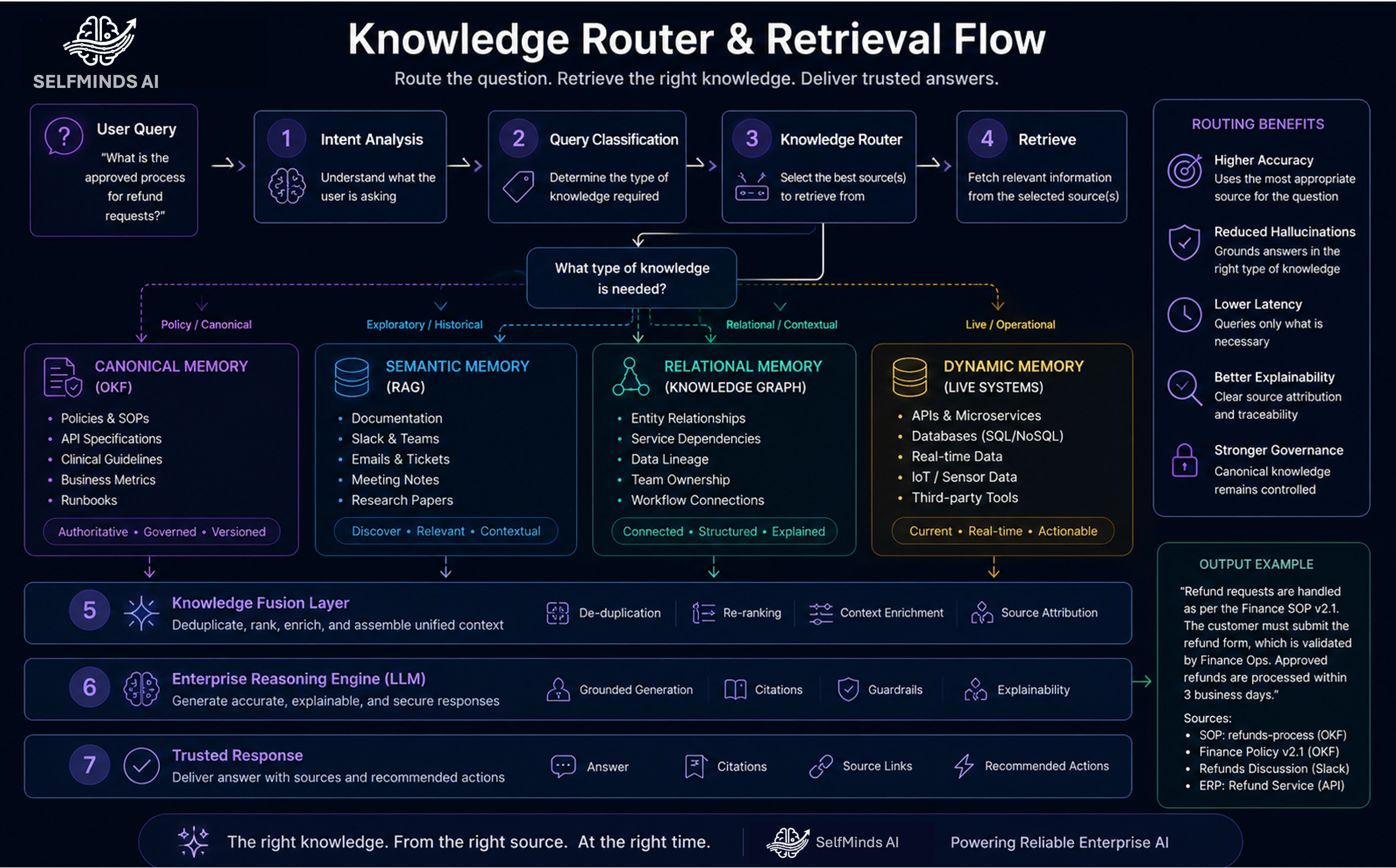
Figure 3 Knowledge Router & Retrieval Flow — intent classification determines which memory layer handles each question before the LLM reasons
Routing Knowledge Instead of Guessing
Different questions deserve different retrieval strategies. Instead of performing the same search every time, our AI agents first determine what type of knowledge is required.
This routing strategy reduces hallucinations while improving both explainability and accuracy.
Knowledge Router
Before retrieving information, AI should determine what type of knowledge the question requires. Routing first dramatically improves reliability while reducing hallucinations — the AI doesn't search everything, it searches the right thing.
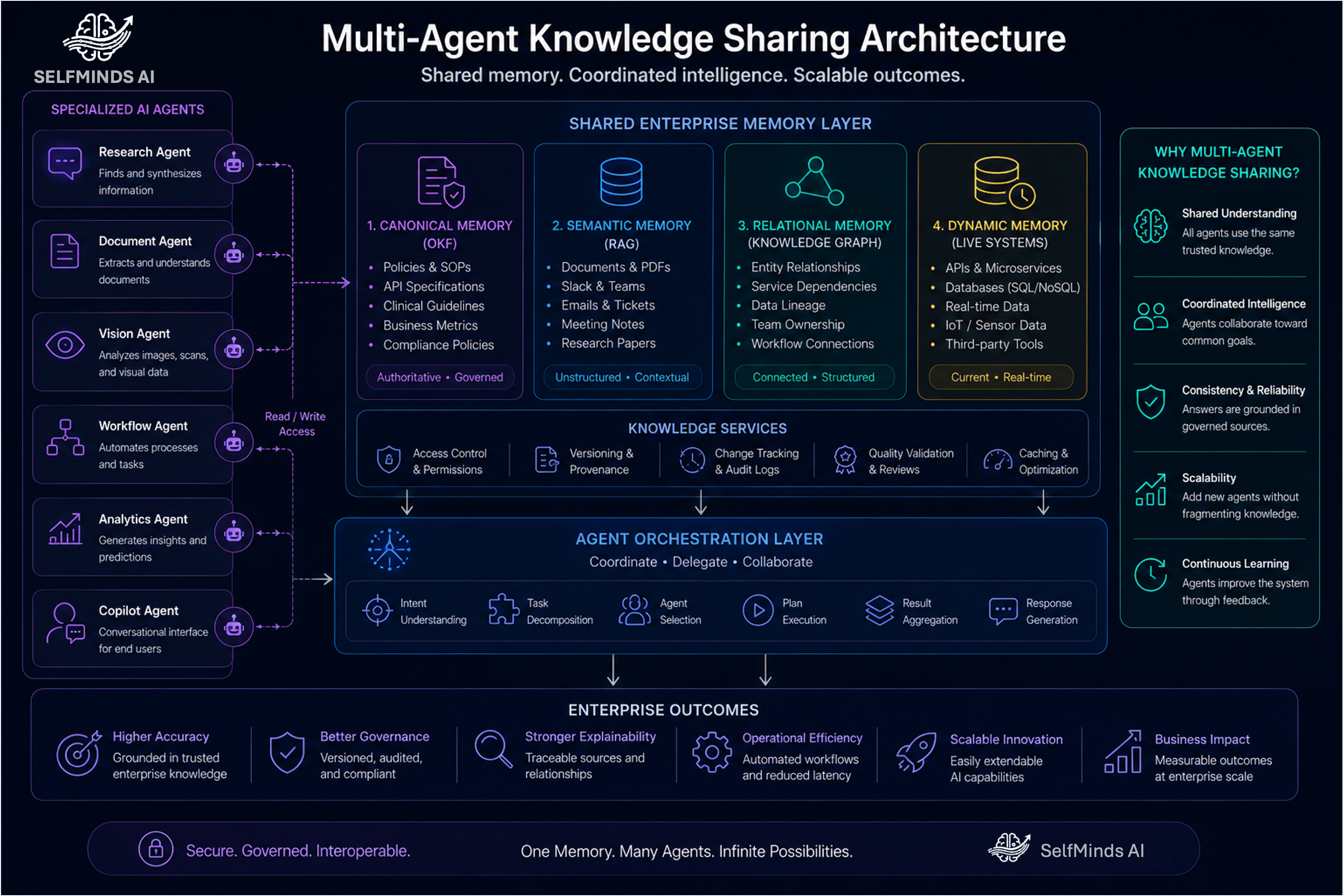
Enterprise AI Is Becoming Multi-Agent
Modern AI systems increasingly consist of specialized agents rather than one monolithic assistant — document understanding agents, computer vision agents, planning agents, workflow automation agents, healthcare copilots, software engineering assistants.
These agents must share knowledge. Without a governed memory layer, each agent develops its own understanding of the organization. That quickly leads to inconsistency. Canonical knowledge repositories provide a common foundation for every agent in the ecosystem.
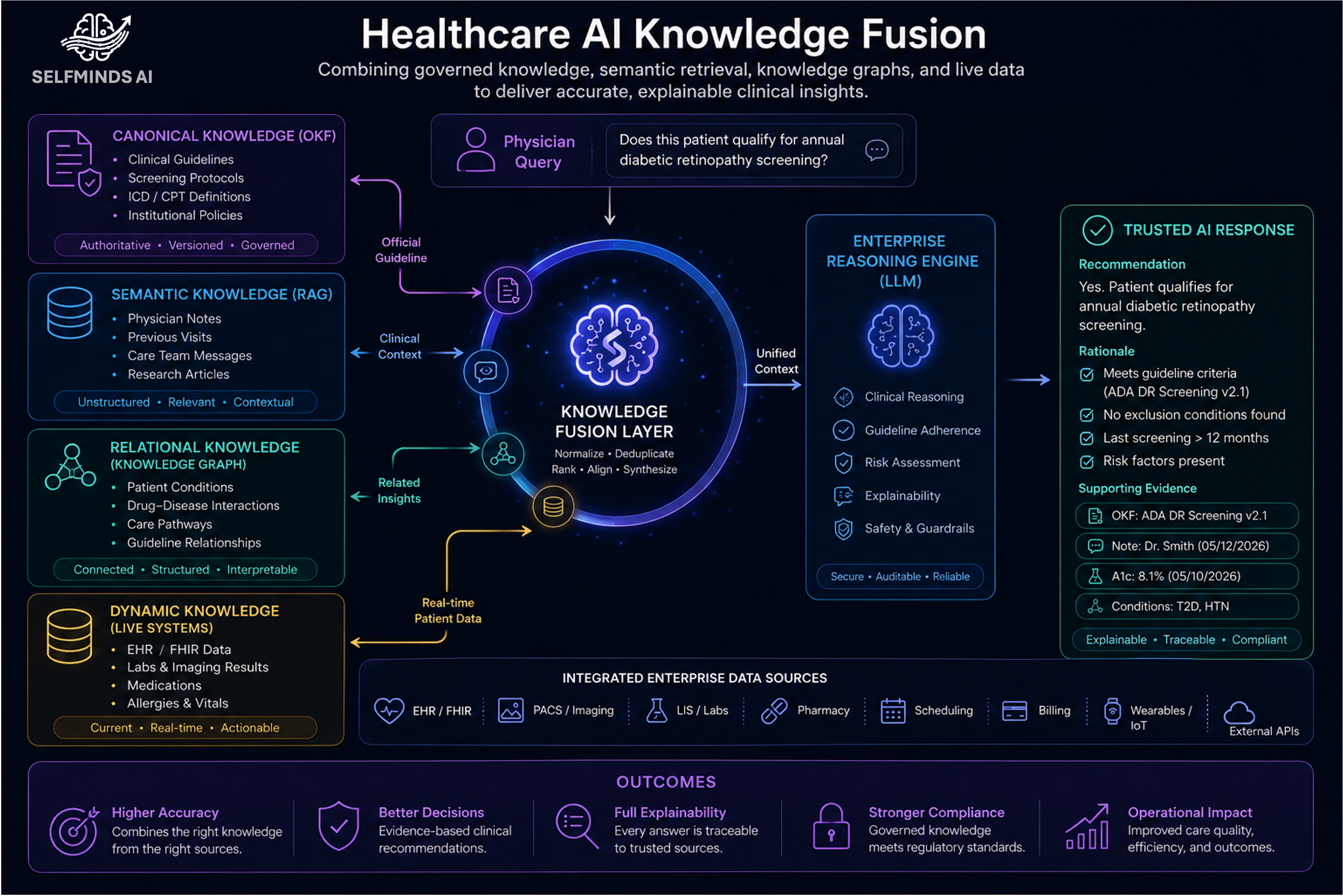
Figure 4 Healthcare AI Knowledge Fusion — layered retrieval combines clinical guidelines, patient history, related diagnoses, and live lab values into a single reasoning context
A Healthcare Example
Imagine a physician asks: "Does this patient qualify for annual diabetic retinopathy screening?"
The AI assistant may combine information from multiple memory systems:
Memory Layer
Example
OKF
Clinical screening guideline
RAG
Previous physician notes
Knowledge Graph
Related diagnoses and comorbidities
Live APIs
Current medications, lab values, appointment history
Rather than depending on a single retrieval mechanism, the AI reasons over all available evidence before producing a recommendation. This is significantly more robust than relying solely on semantic document retrieval.
Beyond Healthcare
The same architecture applies across industries.
Manufacturing
Equipment manuals (OKF), vision inspection systems (computer vision), maintenance history (RAG), live sensor data (APIs) — all unified for intelligent asset management and predictive maintenance.
Financial Services
Regulatory policies (OKF), internal procedures, market data, and transaction systems combined to support compliant decision-making at scale.
Enterprise Software
API contracts, architecture documentation, deployment pipelines, knowledge graphs, and Git repositories unified into a single developer intelligence layer.
Every enterprise has institutional knowledge. The challenge is making it accessible to AI in a reliable way.
Figure 5 Multi-Agent Knowledge Sharing Architecture — specialized agents share a governed canonical knowledge foundation, preventing knowledge fragmentation across the AI ecosystem
Why This Matters
A layered enterprise memory architecture delivers several important advantages across the AI stack.
Higher Accuracy: Critical decisions are grounded in verified knowledge rather than approximate similarity. The AI references what is true, not what is merely relevant.
Better Explainability: AI can reference authoritative documentation instead of opaque vector matches. When a user asks "why did the AI say that?", the answer is a reviewed, versioned document — not a probability score.
Stronger Governance: Knowledge evolves through Git, reviews, and approval workflows. The same processes that govern code govern the AI's knowledge base.
Lower Operational Complexity: Canonical knowledge does not require continuous embedding or re-indexing. A reviewed Markdown file is directly queryable by AI agents without a vector pipeline.
Better Multi-Agent Collaboration: Every agent shares the same trusted foundation. A planning agent and a workflow automation agent will both consult the same approved procedures, not independently hallucinated approximations.
Future-Proof Architecture: Vendor-neutral knowledge remains portable across AI platforms. When you upgrade your LLM or switch your vector database, your canonical knowledge stays intact.
Looking Ahead
Large Language Models will continue to improve. Context windows will grow. Reasoning capabilities will become stronger. Yet none of these advances solve the challenge of enterprise memory.
Organizations that succeed with AI won't simply deploy larger models. They will build better knowledge systems.
At SelfMinds AI, we believe the future of Enterprise AI lies in combining trusted knowledge repositories, semantic retrieval, knowledge graphs, multimodal AI, live enterprise data, and autonomous AI agents into a single intelligent architecture that delivers reliable answers at production scale.
Key Takeaways
Enterprise AI needs multiple memory systems, not just vector search.
RAG is excellent for discovering relevant information, but authoritative knowledge should be governed separately.
Canonical knowledge, semantic retrieval, knowledge graphs, and live enterprise data each serve different purposes.
A Knowledge Router selects the best memory source before the LLM reasons — dramatically improving reliability.
Layered memory improves accuracy, explainability, governance, and scalability.
Multi-agent systems require a shared canonical foundation to remain consistent across specialized agents.
Build Enterprise AI That Thinks with Trusted Knowledge
Whether you're developing an AI copilot, modernizing enterprise search, deploying intelligent document processing, or building autonomous multi-agent systems, the quality of your AI depends on the quality of its memory.
Agentic AI for autonomous decision-making and workflow orchestration
Retrieval-Augmented Generation (RAG) for enterprise search at scale
Open Knowledge Format (OKF) and governed knowledge repositories
Knowledge Graphs for relationships, lineage, and explainability
Multimodal AI for text, images, PDFs, audio, and video
Computer Vision for inspection, analytics, and automation
Healthcare AI for clinical documentation, decision support, and HIPAA compliance
Enterprise Workflow Automation powered by AI agents
PhD, Machine Learning, Kyoto University. Publications at CVPR, ACL, Interspeech, ICIP. h-index 10. Designs production AI systems that combine agentic reasoning, multimodal understanding, and enterprise knowledge architecture.