A wrong answer delivered in polished prose is more dangerous than an obviously broken one, because there's no visible signal that something has gone wrong.
Retrieval-augmented generation demos have a way of looking flawless. You feed the system a handful of well-chosen questions, the retriever pulls back the right paragraph, the model writes a clean answer, and everyone in the room nods. Then the pipeline ships, real users start typing in ambiguous, multi-part, oddly phrased questions, and the documents underneath it all keep changing. Before long, the same system that impressed stakeholders is quietly producing confident, plausible-sounding wrong answers — and often no one notices until a user does.
This gap between demo and production isn't a fluke of bad luck. It's structural, and it shows up in a handful of predictable places: retrieval quality, evaluation blind spots, stale data, and generation behavior that ignores or misuses the context it's given. Understanding where RAG systems actually break is the first step toward catching failures before they reach a customer.
The Demo-to-Production Gap
A RAG prototype is usually built and tested against a narrow, curated set of documents and a handful of representative questions. That environment is nothing like production. Real corpora are messy — inconsistent formatting, duplicate content, outdated policy documents sitting next to current ones. Real users don't ask questions the way engineers imagine; they ask vague, compound, or context-dependent questions the retriever was never tuned for.
The result is a system that performs beautifully in a controlled demo and then degrades in ways that are hard to see from the outside, because the output still looks fluent and confident. Arguably, a wrong answer delivered in polished prose is more dangerous than an obviously broken one, because there's no visible signal that something has gone wrong.
Retrieval Is Usually the Real Bottleneck
When a RAG system gives a bad answer, the instinct is often to blame the language model. In practice, industry data suggests otherwise: research from Atlan, "RAG Accuracy Problems" on enterprise RAG deployments found that roughly 80% of projects experience critical failures, and about 73% of those failures originate at the retrieval stage rather than in the LLM itself. The LLM is frequently doing exactly what it should — synthesizing an answer from the context it was handed. The problem is that the context was wrong, incomplete, or irrelevant in the first place.
A large share of that retrieval failure traces back to chunking decisions made early in the pipeline and rarely revisited. Chunking strategy — the size, overlap, and semantic boundaries used to split source documents — has a documented, material impact on retrieval precision and downstream answer quality: Chroma's chunking research, "Evaluating Chunking" found that different strategies can swing recall by as much as 9 percentage points on the same corpus, and a separate arXiv study on chemistry-domain RAG found chunking strategy impact on retrieval performance to be "comparable to, or greater than, the influence of the embedding model itself." A chunk that's too large buries the relevant sentence in noise; a chunk that's too small strips away the surrounding context needed to interpret it correctly. Teams often pick a chunk size once during prototyping and never test whether it holds up as the corpus grows or diversifies.
Retrieval method matters too. Many teams default to pure vector (embedding) search because it's the most straightforward to set up, but benchmark data tells a more nuanced story: on the WANDS e-commerce retrieval benchmark, hybrid search combining BM25 keyword search with dense embeddings outperformed both BM25 alone and pure vector search, and well-tuned hybrid configurations improved further still (DigitalApplied, hybrid search benchmark analysis). A separate 2026 study on financial-document retrieval even found plain BM25 outperforming dense-only retrieval on exact-match, domain-specific content — reinforcing that keyword search is often better at catching exact terms, product names, or codes that embeddings can blur together, and that combining both approaches compensates for each method's individual blind spots.
It's also worth noting that retrieval degradation isn't limited to chunking and method choice. Using different embedding models — or even different versions of the same model — for indexing versus querying is a documented, if less obvious, source of retrieval breakdown, since the two sides of the search no longer share the same semantic "map" (Towards Dev, on embedding model mismatch). Retrieval quality, in other words, is not a single lever — it's chunking, method, and embedding consistency working together.
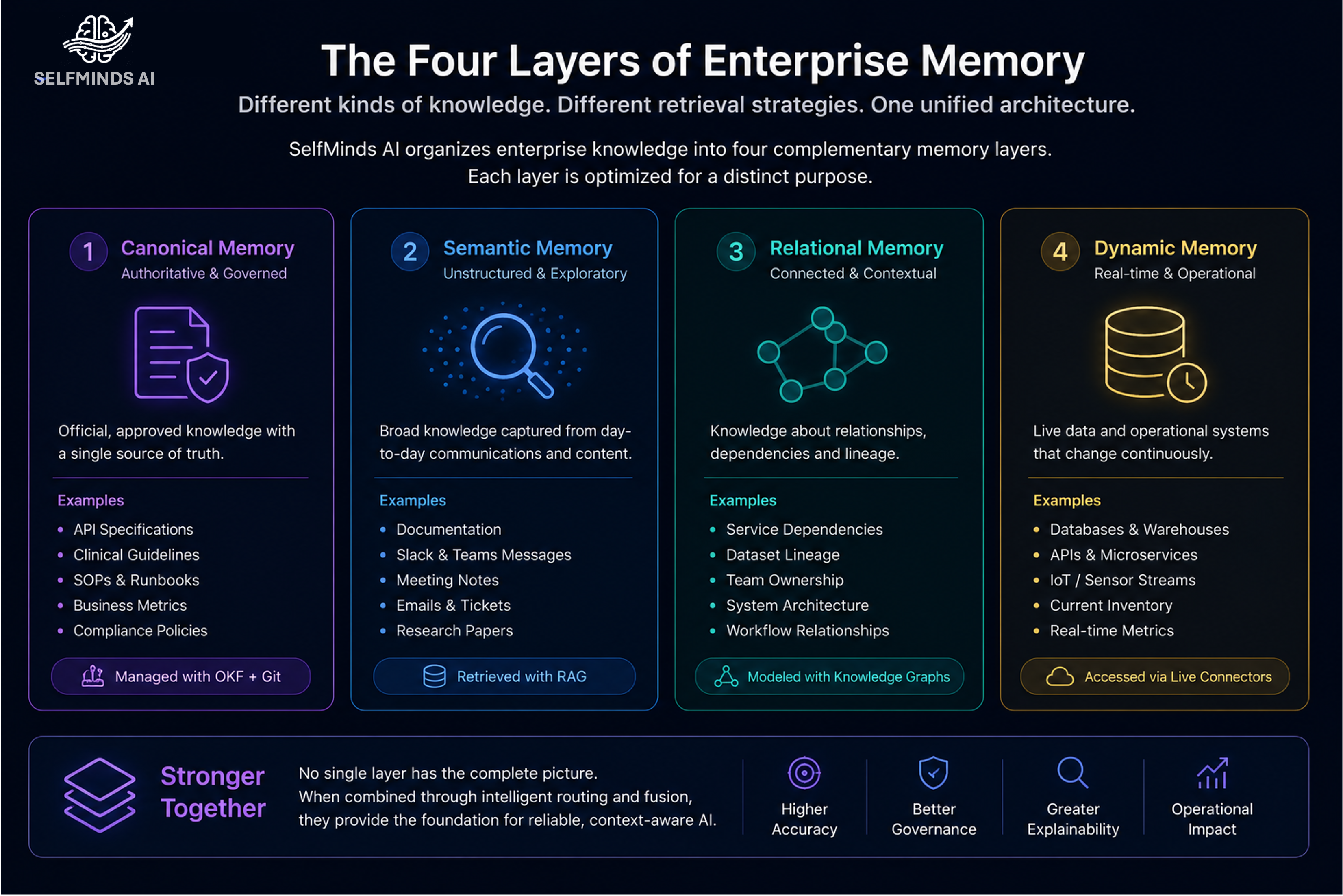
Figure 1 The four layers of enterprise knowledge a production RAG pipeline must navigate. Mismatches between layers — stale indexes, misaligned embeddings, or poor chunking — are where most retrieval failures originate.
Evaluation Blind Spots
Here's the uncomfortable part: most teams have no systematic way of knowing any of this is happening. Independent reporting backs this up — Red Hat Developer, on RAG evaluation gaps notes that most RAG systems reach production with weak evaluation strategies, relying on manual spot checks, small hand-labeled datasets, or generic LLM-as-judge metrics instead of systematic evaluation, producing systems that "appear to work, but fail silently under real user traffic." Without recurring, automated checks against ground-truth question-answer pairs, a retrieval system's quality can decline for weeks before a pattern of user complaints or an embarrassing public mistake forces a review.
The common substitute — spot-checking a handful of outputs by eye, or relying on generic accuracy impressions from a QA team — doesn't scale to the volume and variety of real traffic. Redis has noted that manual review typically covers only a few hundred queries per week, while automated evaluation can score an entire test suite in minutes — a difference in coverage, not just speed (Redis, "RAG System Evaluation"). Standard NLP metrics don't reliably fill this gap either: correlation between BLEU/ROUGE-style scores and human judgments of RAG answer quality has been shown to be consistently low across multiple independent studies (Elastic Search Labs, "Evaluating RAG Metrics"). Evaluation needs to be structural, not occasional: a standing regression suite that runs against retrieval and generation continuously, not a one-time pre-launch checklist.
Stale Indexes and Data Drift
Even a well-built retrieval pipeline decays if the underlying index isn't maintained. Documents get updated, superseded, or deleted, but the vector index built from them often isn't. Stale or infrequently refreshed vector indexes are a major, well-documented contributor to factually outdated responses in production RAG systems — Redis notes that vector search quality can degrade without anyone noticing as the underlying data distribution shifts, and production data from other teams has shown retrieval recall dropping from 0.92 to 0.74 over time purely from stale embeddings, with no code or infrastructure changes involved (Redis, on vector database challenges). The retriever keeps confidently returning a passage from a document that was accurate six months ago, the model writes a fluent answer around it, and nothing in the pipeline signals that the underlying source has since changed.
This is a particularly quiet failure mode because it doesn't require any code change or infrastructure incident to trigger it — it's a byproduct of the world moving while the index stands still. Re-indexing needs to be treated as an ongoing operational responsibility, with clear triggers (document updates, scheduled refresh windows, or drift detection) rather than an afterthought handled only when someone happens to notice something is wrong.
Hallucination Despite "Correct" Retrieval
Even when the retriever does its job and surfaces genuinely relevant context, generation errors can still creep in. Models can partially ignore retrieved passages, misread nuance within them, or blend retrieved facts with their own parametric knowledge in ways that produce subtly wrong answers — technically referencing the right document while getting a detail incorrect. This isn't just a theoretical risk: Chroma's context-rot research, tested across 18 models, found that even a single irrelevant "distractor" document in the retrieved context measurably reduces accuracy, with the effect compounding sharply as more distractors are added (Unite.AI, on retrieval vs. generation hallucination). These errors are especially hard to catch because the retrieval step, if inspected in isolation, looks perfectly healthy. The failure only becomes visible when someone compares the generated answer, sentence by sentence, against the source text — another reason end-to-end automated evaluation matters more than checking retrieval and generation quality separately.
Building Guardrails: Hybrid Search and Continuous Eval
None of these failure modes are surprising once you know to look for them. A practical guardrail strategy generally includes:
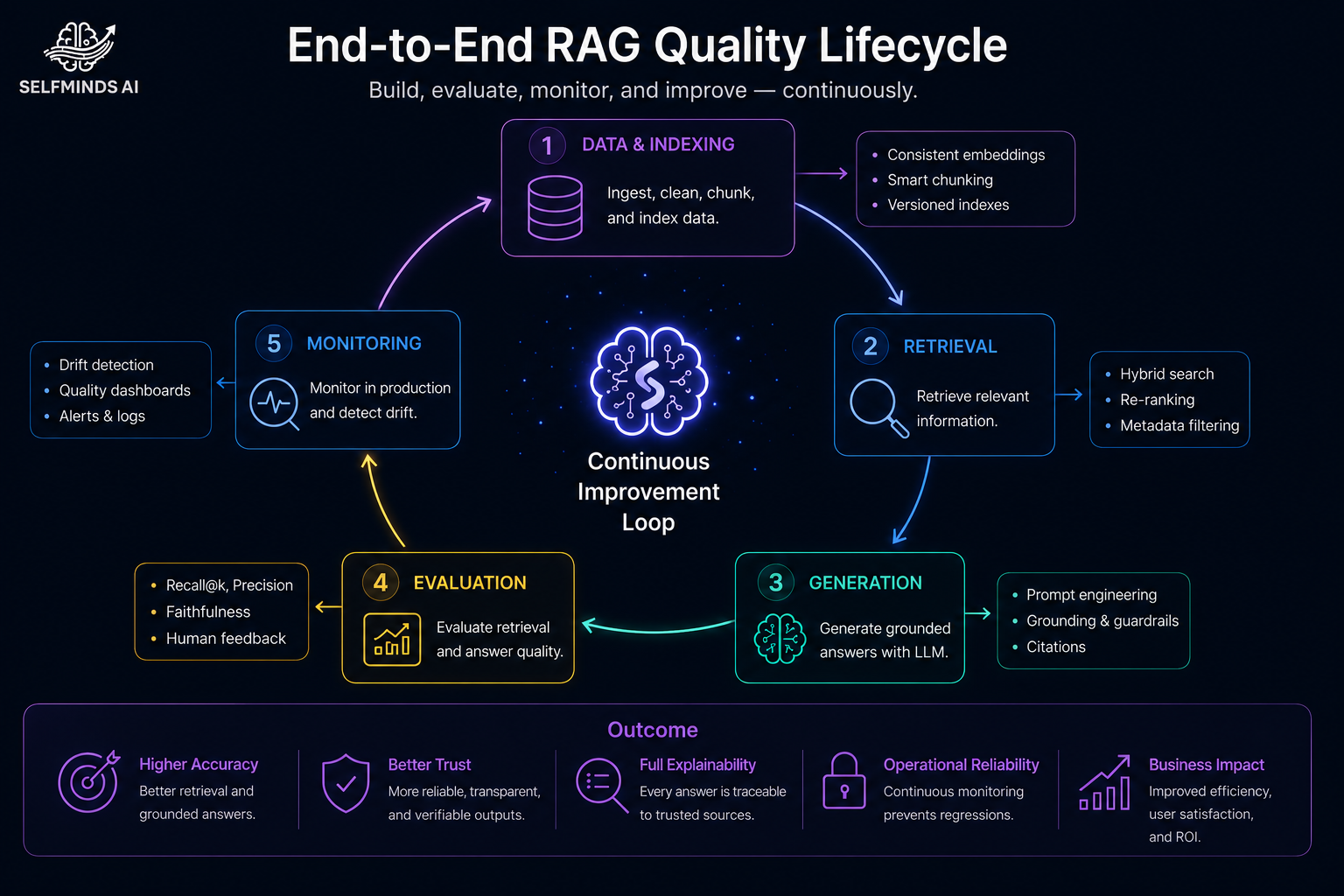
Figure 2 End-to-end RAG quality lifecycle: the continuous observe-evaluate-improve cycle that separates production-grade pipelines from prototype deployments.
Hybrid retrieval that pairs keyword-based search with embedding-based search, rather than relying on vector search alone, to catch cases where exact terms matter as much as semantic similarity.
Reranking retrieved candidates before they reach the generator, so the most relevant passages — not just the top vector matches — end up in context.
Chunking review as an ongoing task, not a one-time setup decision, revisited as document types and corpus size evolve.
Automated regression testing against a growing set of ground-truth question-answer pairs, run continuously rather than only before major releases.
Index freshness monitoring, with defined triggers for re-indexing when source documents change, rather than assuming an index built once stays valid indefinitely.
Production monitoring dashboards that track retrieval quality and answer accuracy over time, so degradation shows up as a trend line instead of a user complaint.
Periodic human review, layered on top of automated metrics, to catch the subtler failure modes — like partial hallucination or misread nuance — that automated scoring alone tends to miss (Label Studio, on human review in RAG systems).
It's worth being honest about the cost of this stack. Hybrid search, reranking, continuous evaluation pipelines, and index-freshness monitoring all add engineering overhead, latency, and infrastructure cost on top of a simpler vector-only setup. For a low-stakes internal tool with a small, stable document set, the full stack may be overkill — a lighter combination (say, better chunking discipline plus periodic automated regression tests) may be the right-sized starting point. The point isn't that every deployment needs every guardrail; it's that teams should choose deliberately, rather than defaulting to the simplest setup and discovering the gaps only after users do.
The common thread across all of these fixes is visibility. RAG systems don't usually fail loudly — they fail quietly, one slightly-wrong answer at a time, until the pattern becomes impossible to ignore. Building in continuous evaluation and retrieval-focused guardrails, sized to the stakes of the deployment, is what turns that slow, silent decay into something a team can see, measure, and fix before their users are the ones who discover it first.
Kourosh Meshgi
Chief Scientist, SelfMinds AI
PhD, Machine Learning, Kyoto University. Publications at CVPR, ACL, Interspeech, ICIP. Research in continual learning, computer vision, NLP, and agentic systems. h-index 10.